The grid method of multiplication is a step-by-step way children are taught in primary school to multiply larger numbers by breaking them into smaller parts. It’s a method that helps children work with organised jottings.
Parents often ask me:
“What is the grid method … and why are children learning it instead of the method I used at school?”
If you’ve ever wondered this too – you’re in the right place.
What is the Grid Method of Multiplication? (Explained Simply)
The grid method is a way of multiplying numbers by splitting them into tens and ones, multiplying each part separately and adding the results together.
It builds on children’s knowledge of partitioning the number, multiplying each part and then recombining to reach an answer.
It helps children:
- Understand how multiplication works
- Apply their times tables knowledge
- Build confidence with multiplying multiples of 10 and 100
- Build a strong foundation in which to teach the column method at a later date
The grid method is not designed to replace traditional methods. It is a steppingstone that secures children’s understanding so that they experience more success with column multiplication.
Why Do Schools Teach the Grid Method?
The grid method supports the three key aims of the National Curriculum for England:
- Fluency – understanding number patterns and relationships
- Reasoning – explaining how maths works
- Problem solving – having confident methods, including jottings, in which to solve problems in different contexts
Rather than memorising steps, children see what’s happening inside the calculation to develop a deeper understanding for the longer term, not just getting the answer in the moment.
Before Using the Grid Method
Before your child starts to learn about the grid method, they should:
- Know some times tables, or at least understand them and confidently use a multiplication mat
- Recognise multiplication as repeated addition
- Understand how to multiply a number by 10
- Be able to multiply multiples of 10
These are the foundation skills that your child will draw on and use in the method.
How to Use the Grid Method (Step-by-Step)
Let’s start with a simple example:
35 × 4
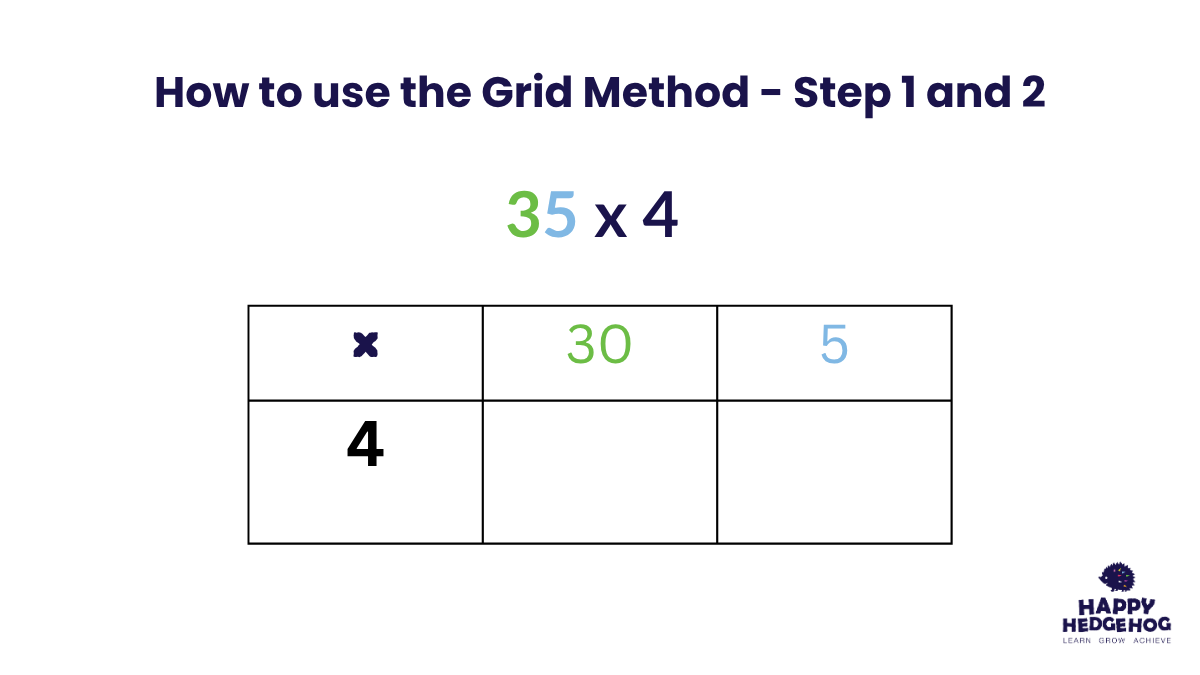
Step 1: Draw the Grid
35 is a two-digit number and therefore you will need to draw a grid with two columns. One for tens and another for ones (see image 1).
Step 2: Partition the Number
Split the calculation into its place value parts:
35 × 4
- 30 (tens)
- 5 (ones)
- 4 (multiplier)
Write 30 and 5 across the top of the grid and 4 down the left-hand side.
Step 3: Multiply Each Part
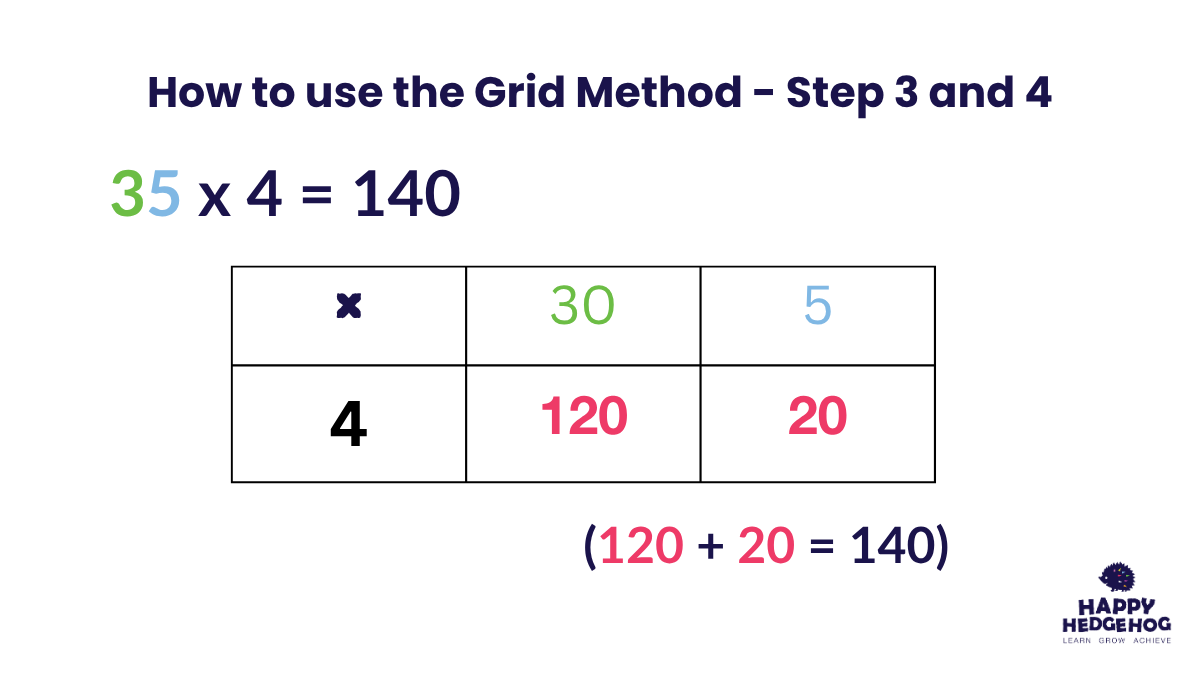
This is where pupils use their knowledge of times tables and multiplying multiples of 10 to multiply each part:
- 30 × 4 = 120
- 5 × 4 = 20
Write each of the answers in the column underneath (see image 2).
Step 4: Add the Answers Together
Add the answers in each of the columns together.
120 + 20 = 140
Final answer: 140
Why the Grid Method Works So Well
The grid method helps children:
- Break numbers into their place value parts (tens, hundreds and ones)
- Use known facts (like 3 × 4) and build on them
- See why multiplication works
- Practise multiplying by 10, 100 and 1000
- Build the perfect foundation for the expanded method of column multiplication
Can the Grid Method Be Used for Bigger Numbers?
Yes. Once children have mastered the grid method to multiply a two-digit number, they are usually ready to work with three-digit numbers.
- For a 3-digit number × 1-digit – simply add one more column
- For a 2-digit number × a 2-digit number – simply add one more row
Note: Children often find moving to 2 digits × 2 digits more difficult and may need to spend more time practising multiplying multiples of 10, for example:
- 20 × 40
- 50 × 60
You might also find this helpful:
How to Multiply Multiples of 10, 100 and 1000 (with FREE KS2 PDF worksheet)
Is the Grid Method the Best Method?
My philosophy is to always teach children methods that develop understanding. When we teach processes without understanding, children forget the steps and can’t recognise where they have gone wrong.
The grid method is excellent for:
Developing understanding
Improving children’s accuracy in calculations
Improving children’s confidence and fluency
But it is:
Not the fastest method
Not usually used in the longer term
When children develop fluency in this method with larger numbers, they are normally ready to be taught the more traditional method of column multiplication.
When Do Children Move to Column Multiplication?
The National Curriculum tends to introduce it around Year 4, but sometimes it is best to delay it a little until the child is ready for the most success.
Children are ready when they:
- Have a good grasp of their times tables and can confidently use a multiplication mat for any tricky ones
- Understand place value and can partition numbers
- Can multiply a multiple of 10 mentally
Some children move on too quickly and this can knock their confidence and fluency.
Don’t worry about spending more time on this skill to develop fluency and confidence with it. Practice enables confidence to grow.
A Note for Parents
It can feel confusing when maths is taught differently from when you learned it.
Methods like the grid method are designed as foundation steps to build bridges to the next mathematical concepts.
The most important thing is developing fluency before moving on. Racing through skills without lots of practice to consolidate learning and build confidence creates gaps, which cause mistakes. Mistakes are an essential part of learning, but too many repeated mistakes can cause frustration and knock children’s confidence.
Happy Hedgehog Tip
If your child is struggling with this:
- Check their times tables knowledge
- Check they are confident with multiplying numbers like 50 × 4 or 300 × 6
- Ask them to talk through each step
Don’t be afraid to go back to work with smaller numbers to build confidence again. Maths should feel doable and not overwhelming.
You Might Also Like
If you found this blog helpful:
Explore more parent-friendly maths guides: