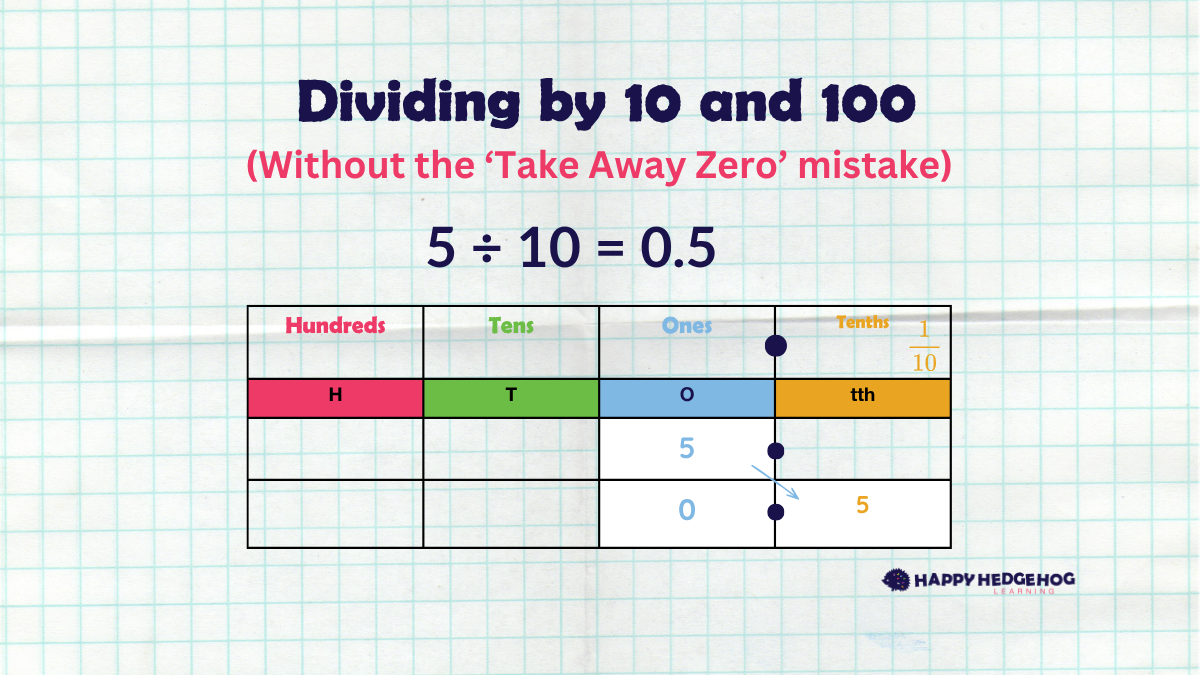
Multiplying and dividing by 10, 100 and 1000 is one of the most misunderstood concepts in maths – especially when children are taught to “just add a zero”.
As a teacher, it’s something I find myself unpicking every year with Year 4, Year 5 and Year 6 pupils.
Multiplying by 10: Why You Should Never Just Add a Zero
You may have heard the advice:
“Just add a zero.”
I completely understand where this comes from – I was probably taught this myself at school. However, the truth is that it doesn’t always work.
For example:
2.3 × 10 = 23
This is exactly why “just add a zero” can cause confusion. There are no zeros in the answer, so what’s really happening?
The Key Idea: Understanding the Shift in Place Value
A strong foundation in maths comes from understanding place value – the value of each digit in a number and the patterns that occur when calculating.
For example:
235 = 200 + 30 + 5
When we multiply by 10, each digit becomes 10 times greater, so its place value shifts one column to the left.
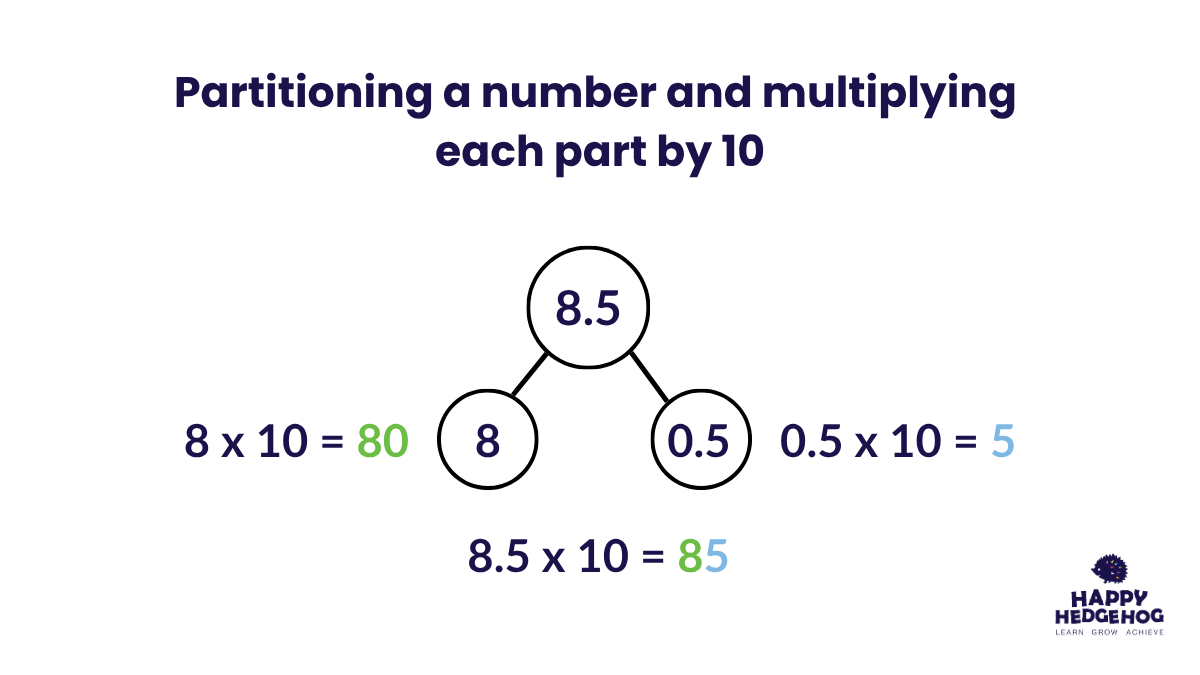
Children can explore and test this idea by partitioning the number, multiplying each part by 10 and then recombining the parts to reach the answer.
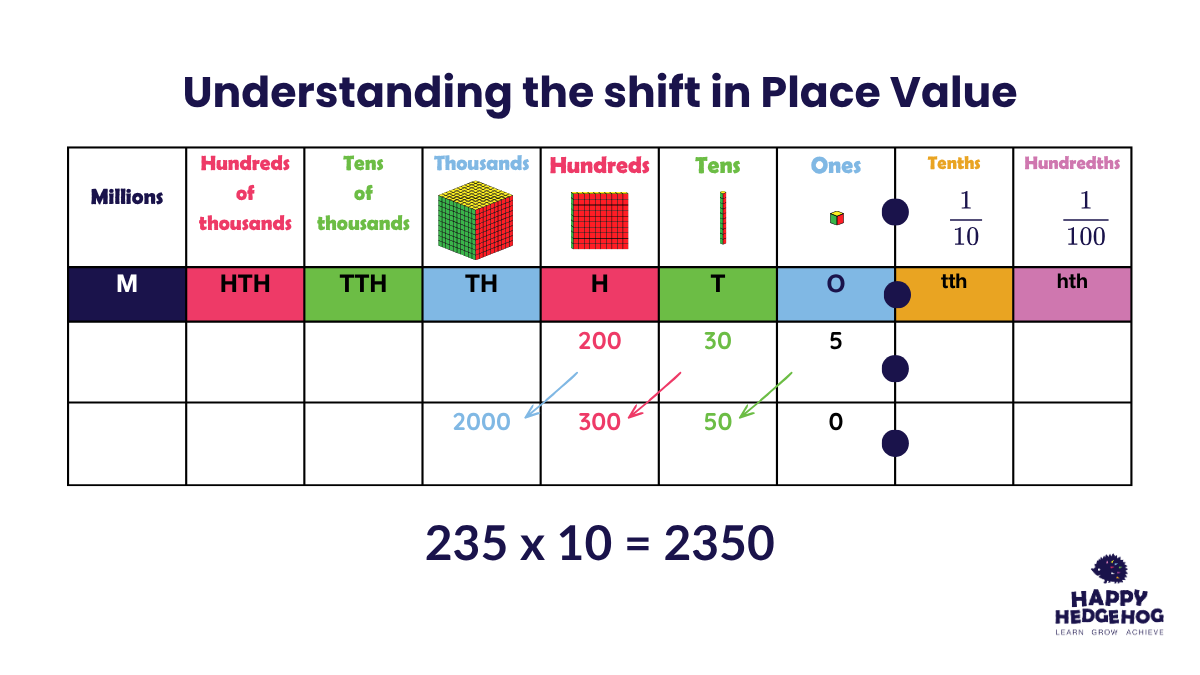
For example:
235 × 10 = 2,350
- 2 hundreds become 2 thousands
- 3 tens become 3 hundreds
- 5 ones become 5 tens
Why “Adding a Zero” Causes Problems
Some people argue that adding a zero is just a helpful shortcut or “maths hack”. However, once a child learns a shortcut, they trust it to work in every situation – and it simply doesn’t.
When a method has worked well for months and then suddenly fails, it causes confusion and frustration. Children can struggle to unpick the mistake because there is a gap in their understanding.
Common Mistakes to Look Out For
One of the most common mistakes I see in Year 4, Year 5 and Year 6 is:
8.5 × 10 = 8.50
or
8.5 × 10 = 805
Adding zeros does not change the value of each digit.
These mistakes show that the child does not yet understand how the value of each digit changes.
In the first mistake, the answer has exactly the same value as the original number.
In the second mistake, the placing of the zero has made the answer almost 100 times bigger.
What Children Need to Understand Instead
When multiplying by 10, particularly when working with decimals, children need to think about the value of each digit.
8.5 is made up of 8 ones and 5 tenths.
If we partition the number and multiply each part:
- 8 × 10 = 80
- 0.5 × 10 = 5
Therefore, 8.5 × 10 = 85
Happy Hedgehog Tip
If your child says they are “adding a zero”, ask them:
“What is happening to the value of each digit?”
This encourages mathematical thinking and helps children build the understanding they need to spot mistakes.
Building Real Understanding
When children understand place value, they can:
- Multiply by 10, 100 and 1000 confidently
- Multiply by multiples of 10
- Spot mistakes
This understanding becomes essential when children move on to topics such as percentages and ratio.
Extending This Skill to Multiplying by 100, 1000 and Beyond
Once children understand that multiplying by 10 changes the place value of each digit by one column to the left, they can extend the same understanding to larger powers of 10.
- × 10 – digits shift one place to the left
- × 100 – digits shift two places to the left
- × 1000 – digits shift three places to the left
Calculations involving multiples of 10 also become much easier because children begin to recognise and use known facts.
For example:
7 × 3 = 21, therefore 70 × 3 = 210
A Final Thought
Maths is like a jigsaw.
If children are given shortcuts to solve calculations, it can restrict their understanding and they may fail to spot patterns and relationships in numbers. Suddenly, the pieces no longer fit together.
Don’t worry if your child finds this tricky at first or jumps to put zeros everywhere. Let them make a few mistakes and ask:
“Can you explain why you think that answer is correct?”
Often, children’s explanations reveal exactly where the misunderstanding lies.
When children explore what truly happens in maths, they build strong number sense that they will draw on for life.
What’s Next?
Understanding multiplication by 10, 100 and 1000 is only part of the picture.
Read my related blog posts: