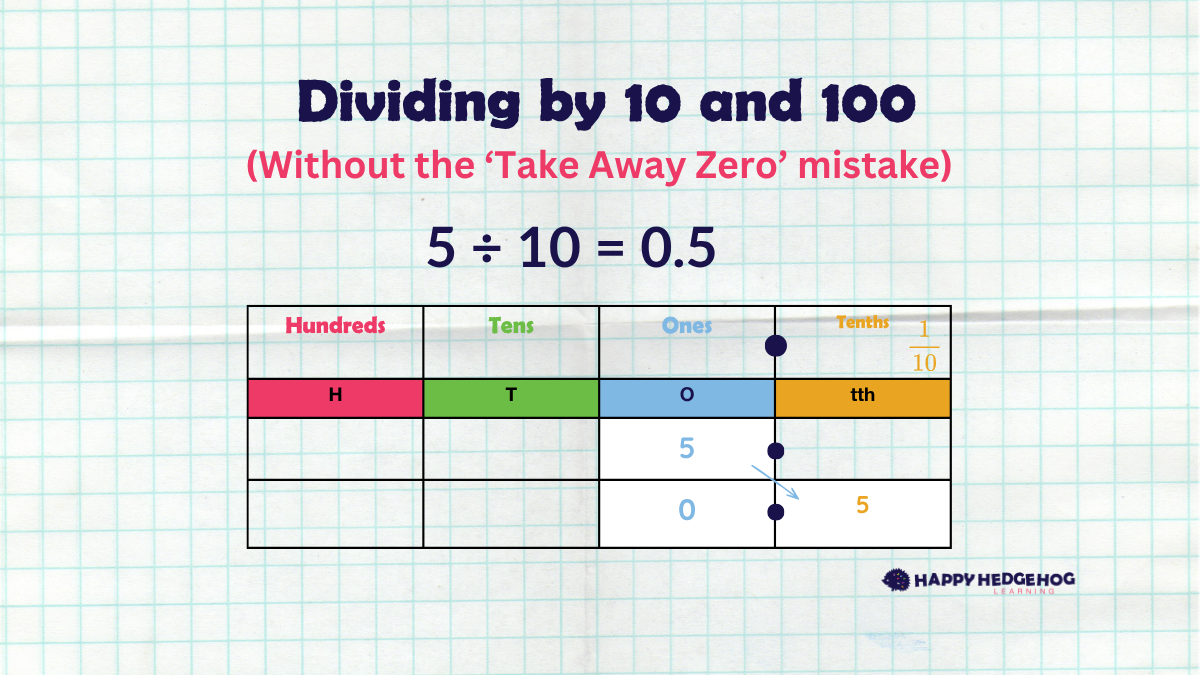
Have you ever been told that when you divide by 10 you simply “take away a zero”?
It sounds like a helpful shortcut, but it quickly causes confusion. As soon as children begin solving calculations such as 5 ÷ 10 or 16 ÷ 10 in Year 4, there isn’t a zero to remove.
For Example
5 ÷ 10 = 0.5
There are no zeros to remove … so how should children work through this question?
Why “Take Away a Zero” Doesn’t Work
Let’s look at a common example from a Year 4 arithmetic test:
16 ÷ 10
There are no zeros to remove, so children who have relied on this shortcut often become confused.
Two common misconceptions are:
- 305 ÷ 10 = 35
A zero has simply been removed. - 42 ÷ 10 = 42
Nothing has changed because there wasn’t a zero to remove.
Both answers show that the child is following a remembered rule rather than understanding what is happening to the value of each digit.
These errors happen because children are following a process without understanding it.
Dividing Is the Inverse of Multiplying
When children understand that dividing by 10 is the inverse, or opposite, of multiplying, they begin to recognise the pattern.
- When we multiply by 10 – digits increase in value by moving one place to the left.
- When we divide by 10 – digits decrease in value by moving one place to the right.
How to Divide Using Place Value
Instead of adding or removing zeros, we teach children to move digits between place value columns.
- Divide by 10 – every digit decreases in value and moves one place to the right.
- Divide by 100 – every digit decreases in value and moves two places to the right.
- Divide by 1000 – every digit decreases in value and moves three places to the right.
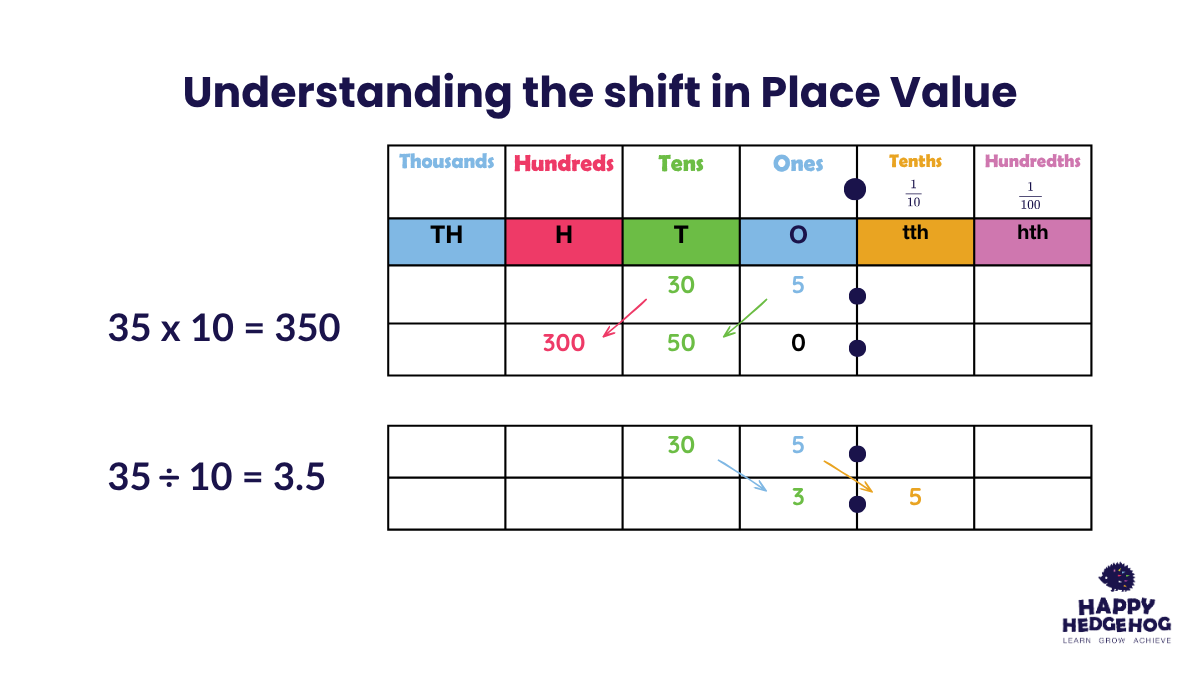
A place value chart demonstrates how the value of each digit changes.
Example 1
35 ÷ 10 = 3.5
35 is made up of:
- 30
- 5
The 3 starts as 3 tens and becomes 3 ones.
The 5 starts as 5 ones and becomes 5 tenths.
Answer: 35 ÷ 10 = 3.5
This is why the decimal point appears. It separates the whole number part from the fractional part of the number. The 5 digit now represents five tenths.
Example 2
106 ÷ 10 = 10.6
106 is made up of:
- 100
- 6
100 ÷ 10 = 10
6 ÷ 10 = 0.6
Answer: 106 ÷ 10 = 10.6
Nothing has been removed. Every digit has simply moved one place to the right, making its value ten times smaller.
Why This Method Works
Teaching children to think about place value instead of memorising shortcuts helps them:
- Understand what is happening to the number
- Avoid common arithmetic mistakes
- Build confidence when working with decimals
- Develop reasoning and problem-solving skills
- Create a secure foundation for secondary school maths
Happy Hedgehog Tip
When practising at home, ask your child:
- Which digits moved?
- What is the value of each digit now?
These questions encourage children to think about place value instead of trying to remember a shortcut.
Teaching Tip and Free Resource
One of the most effective ways to teach and explore this skill is using a place value chart.
Encourage children to:
- Physically move digits between columns (squared paper can be useful for this)
- Use coloured counters for each digit
- Slide each counter one column to the right when dividing by 10
This makes the learning visual, practical and memorable.
Real-Life Examples
Example 1
A pack of 10 yoghurts costs £2.80. How much does one yoghurt cost?
£2.80 ÷ 10 = £0.28 (28p)
Example 2
If a pack of 10 water bottles costs £3.70, what is the value of each bottle?
£3.70 ÷ 10 = £0.37 (37p)
Final Thought
If your child is using the method of “take away a zero”, it might feel easier in the short term, but building a strong understanding of place value will support them far more in the long run.
If your child is still saying “take away a zero”, don’t worry. It’s a very common misconception. With plenty of practical place value work, they’ll soon understand what is really happening when numbers are divided by 10, 100 and 1000.
Download your FREE Place Value Chart
to explore this concept further.
What’s Next?
Understanding how to divide by 10, 100 and 1000 is just the beginning.
Next, children learn to apply this to more complex calculations:
- Dividing multiples of 10, 100 and 1000
- Working confidently with decimals
- Reasoning in real-life contexts
Continue helping your child build strong mathematical foundations and read one of my other blogs:
- How to Multiply by 10, 100 and 1000 (Without Adding Zeros)
- How to Divide Multiples of 10, 100 and 1000 (Coming Soon)
- What is the Grid Method of Multiplication? (A simple Guide for Parents)