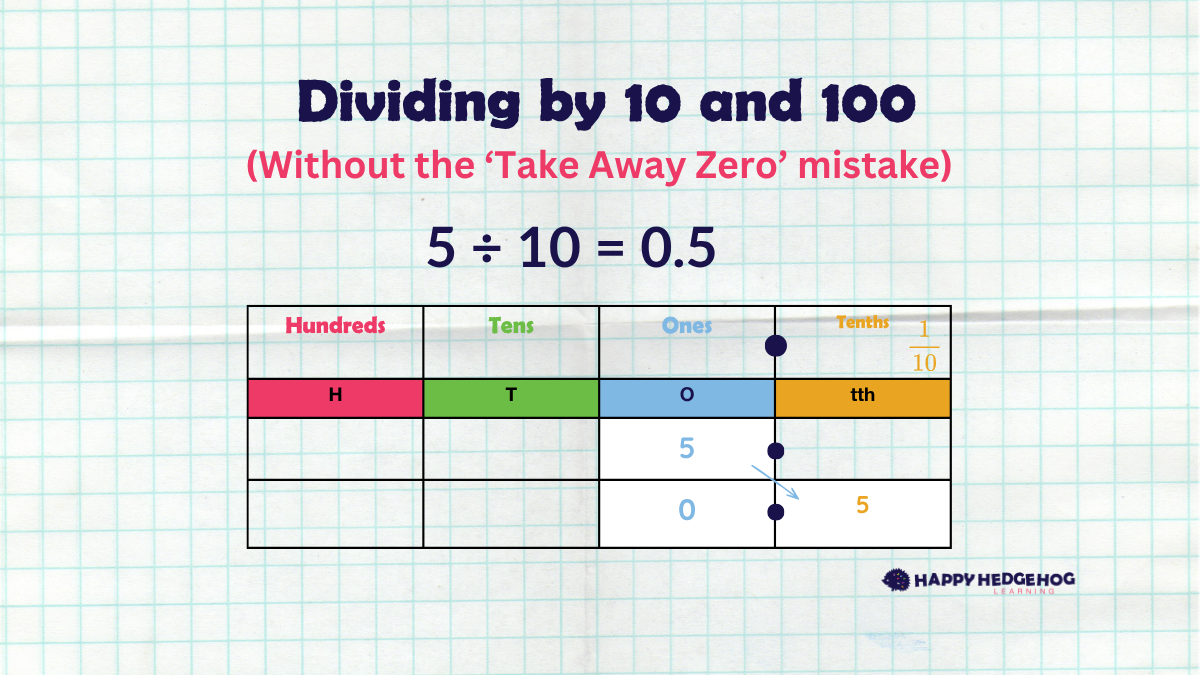
Multiplying by multiples of 10, 100 and 1000 is a calculation that can often be done mentally when the right mathematical foundations are in place. This guide is perfect for parents looking for clear KS2 methods for multiplying by multiples of 10, 100 and 1000.
As a teacher, I often see pupils use traditional written multiplication methods for these questions because they have not spotted the times-table fact hidden within the calculation or the opportunity to use their knowledge of multiplying by 10, 100 and 1000.
Multiplying by 20 is NOT just ‘add a zero’ … and here’s why
You may have heard the advice:
“Just add a zero”
In my previous blog (Multiplying by 10, 100 and 1000) I explained the reasons why this maths hack can lead to confusion, particularly when working with decimals.
In Year 4, children are introduced to decimals. By Year 5 they begin to explore multiplying decimals by whole numbers and later multiples of 10 too.
For Example
Here’s a common mistake:
0.3 × 20 = 60 ❌
0.3 × 20 = 6 ✓
There are no zeros in the answer … so what’s really happening?
Common Misconceptions
Question: 0.3 × 20
0.3 × 20 = 60 ❌
A child will often explain, ‘I multiplied 3 by 2 and added a zero.’
However, 0.3 is three tenths, not 3.
We can think of the calculation as finding three tenths of 20:
- First, calculate 3 × 20 = 60.
- Then divide 60 by 10, because 0.3 (three tenths) is ten times smaller than 3.
Therefore, 0.3 × 20 = 6 ✓
Question: 4 × 50
4 × 50 = 20 ❌
A child will often explain, ‘The multiplier had a zero so the answer will end in a zero.’
We know that 4 × 5 = 20
However, 50 is ten times greater than 5 so the answer must also be ten times greater:
4 × 50 = 200 ✓
Question: 120 × 50
120 × 50 = 600 ❌
A child will often explain, ‘There are two zeros in the question so the answer must have two zeros.’
12 × 5 = 60
12 × 50 = 600
Therefore, 120 × 50 = 6 000 ✓
These examples demonstrate why counting or adding zeros is not a reliable method. Children need to consider the value of each number, and how many times greater or smaller than the known times-table fact their answer will be.
To confidently multiply by multiples of 10, children need:
- A strong understanding of times-tables facts
- A secure understanding of multiplying by 10, 100 and 1000
- A secure knowledge of the place value of decimals
The Times-Tables Connection
A strong foundation in times-tables helps children recognise the fact hidden within the calculation, and complete it mentally and efficiently.
The Multiplying by 10 Connection
Example: 20 × 40:
Answering this type of question efficiently also requires a secure knowledge of multiplying by 10.
When children recognise that 20 × 40 is the same as 2 × 4 × 10 × 10, they can use their times-tables fact to calculate the answer mentally:
2 × 4 × 10 × 10 = 800 ✓
20 × 40 = 800 ✓
Using place value knowledge is a vital step in checking whether an answer can be true or not.
I often spend time exploring patterns like this as the numbers create a visual shape. This proves really useful when working with decimal numbers too.
Example: 8 × 700
8 x 7 x 100 = 5 600
Example: 3 000 × 4
3 x 4 x 1000 = 12 000
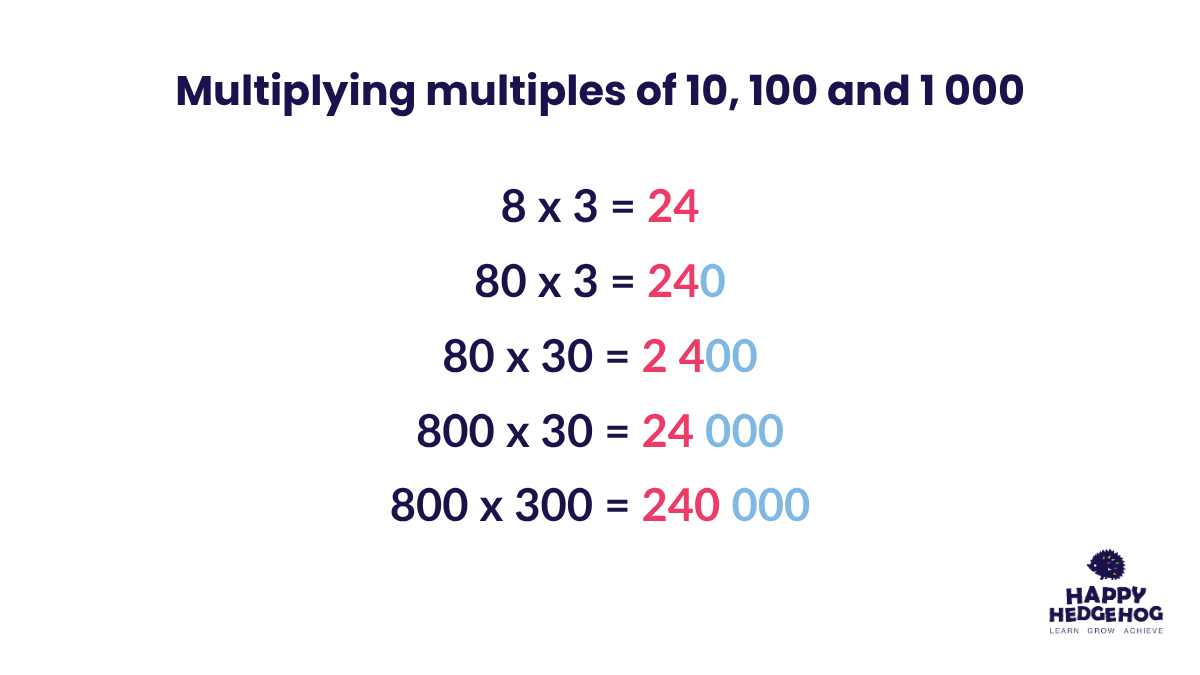
An example of how multiplying by multiples of 10, 100 and 1000 changes a times-tables fact.
The Place Value of Decimals Connection
When decimals are involved, children need to recognise that a number of tenths is 10 times smaller than the corresponding whole number digit. For example:
0.8 × 3 =
8 × 3 = 24 is the times-table fact at the root of the question
To solve this question: 8 × 3 ÷ 10 = 2.4
Therefore, 0.8 × 3 = 2.4 ✓
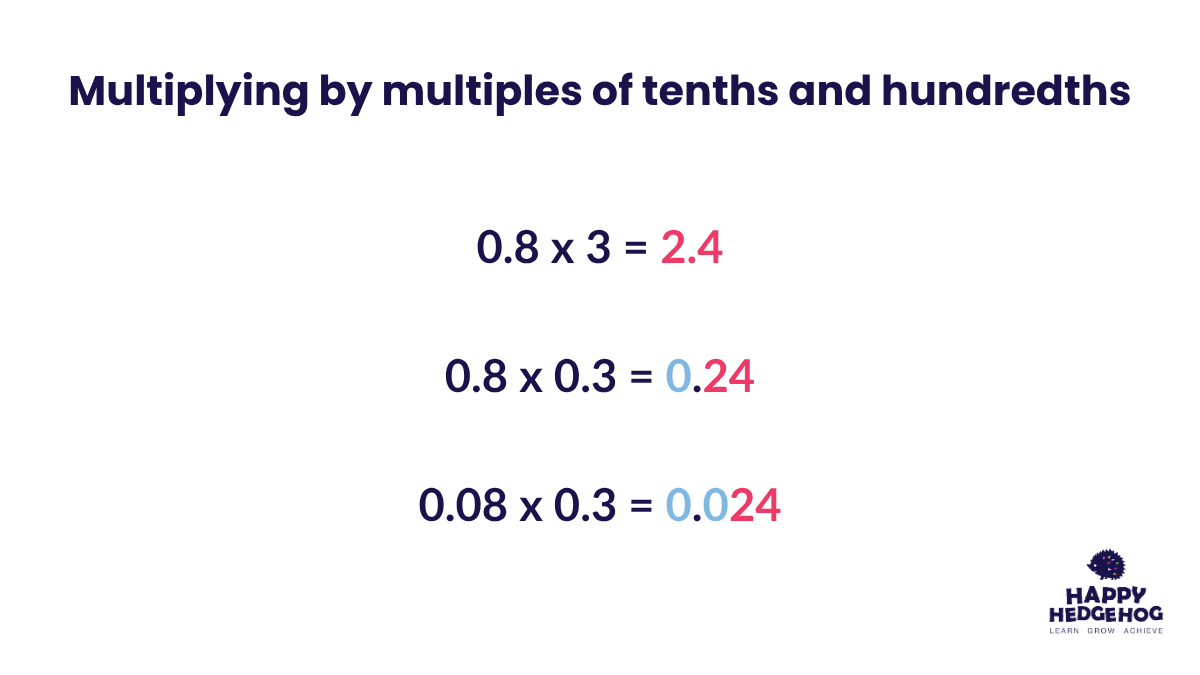
An example of multiplying decimals using times-tables and place value knowledge.
Multiplying by Multiples of 10 in Real Life
Adults use this skill regularly in everyday life. Here are just two examples:
I save £5 every week for 20 weeks, how much money will I have saved?
5 × 20 = £100
If each water bottle costs £1.50, how much will 30 water bottles cost?
1.5 × 30 = £45
A Simple Step-by-Step Method
When children feel unsure, it’s best to work within the times-tables facts they’re secure in, and focus on questions with just one multiple of 10. Keeping the cognitive load low helps pupils practise the process in steps, recognising success as they work.
Let’s break it down:
Example: 40 × 5 =
Step one: What times-table fact is hidden within the question?
4 × 5 = 20 …
Step two: Apply knowledge of multiplying by 10.
If 4 × 5 is 20, the answer to 40 × 5 will be 10 times bigger.
Answer: 40 × 5 = 200
Happy Hedgehog Tip
Encourage your child to find the times-table fact hidden inside the calculation before doing anything else. Then ask, “How is each number in the question different from the times-table fact you know?” This helps them use place value rather than simply counting zeros.
Children Often Miss the Commutative Law
If children are only presented with questions in one format, they begin to believe that this method only applies to examples like those above. It is important for children to recognise that multiplication can be completed in either order. For example:
40 x 5 = 200
5 x 40 = 200
Seeing calculations presented in both directions helps children recognise when the same method can be applied.
Next Steps
Once a child has mastered working with multiples of 10 on one side confidently, they may be ready to multiply two multiples of 10:
50 × 30 =
5 × 3 = 15
5 × 3 × 10 = 150
5 × 3 × 10 × 10 = 1 500
Therefore, 50 × 30 = 1 500 ✓
It’s important to recognise that skills like this take lots of practice to both master and apply confidently.
Quick Practice
Can your child solve these mentally?
- 3 × 40 =
- 50 × 6 =
- 40 × 50 =
- 8 × 700 =
- 0.5 × 9 =
Answers
- 3 × 40 = 120
- 50 × 6 = 300
- 40 × 50 = 2 000
- 8 × 700 = 5 600
- 0.5 × 9 = 4.5
What’s Next
Understanding how to multiply by multiples of 10 is only part of the picture.
Read my related blog posts:
- Dividing by 10, 100 and 1000 (Without the ‘Take Away a Zero’ Mistake)
- How to Divide Multiples of 10, 100 and 1000 – Coming Soon
If you found this blog helpful:
- Join my email list for fortnightly Maths tips and resources.
- Explore more parent-friendly Maths guides on the blog.
- Find out about my new Year 6 Maths Club starting in September 2026.
Have fun learning together!