Learning times tables, also referred to as multiplication facts, can often bring stress, anxiety and frustration. Many children find them tricky to remember and, for parents, it can feel like an uphill battle.
Learning times tables is one of the most important foundations for maths success in primary school.
My Honest Experience With Times Tables as a Child
I’ll be honest – I didn’t know my times tables confidently in primary school. I carried that lack of fluency into high school too, and it did affect my ability to understand the more abstract mathematical concepts I was challenged with at the time.
I remember:
- The anxiety of weekly times tables tests
- Being put on the spot to answer questions
- Struggling with calculations that others seemed to find easy
As a teacher, I can clearly see the impact times tables have on mathematical fluency and confidence.
Children who know their times tables demonstrate more confidence, fluency and willingness to engage in mathematical challenge.
Why Times Tables Matter So Much
Maths is built on patterns and connections, and times tables are a key piece of that puzzle.
When children know their multiplication facts, they can:
- Solve calculations more quickly and accurately
- Work out multi-step calculations mentally
- Understand and solve division calculations
- Access more complex maths topics with confidence
Times tables underpin:
- Multiplication and division
- Fractions
- Percentages
- Ratio and proportion
- Sequences
- Algebra and so much more
Without them, maths can feel slow and overwhelming, and this increases the cognitive load on a child when calculating.
With this knowledge secured, everything becomes easier.
Why Times Tables Matter Beyond Primary School
Times tables knowledge isn’t just helpful – it’s essential for tests and exams.
In Year 6 SATs:
- Children complete a Mental Arithmetic paper
- In 2025, approximately 26 out of the 36 questions required secure multiplication and division fact knowledge
- They have just 30 minutes to answer all questions
In the 11+ entrance exam:
- Children are tasked with around 50 or more complex questions in 50 minutes or less
This requires:
- Fast recall
- Strong number sense
- Efficient strategies
And it doesn’t stop there …
At GCSE level, students face a non-calculator paper, where fluency with multiplication facts is still crucial.
Weak times tables knowledge = slower calculations = increased cognitive load = increased pressure and anxiety
Where Times Tables Learning Begins
Times tables learning doesn’t suddenly start in Year 3 or Year 4.
It begins much earlier.
In Reception and Year 1, children:
- Count in steps of 2, 5 and 10
- Use physical objects to group and count
- Begin to understand the concept of equal groups
As they progress, they move on to work with visual representations and use jottings such as arrays.
An array helps children see that:
- 3 × 5 = 15
- 5 × 3 = 15
- 15 ÷ 3 = 5
- 15 ÷ 5 = 3
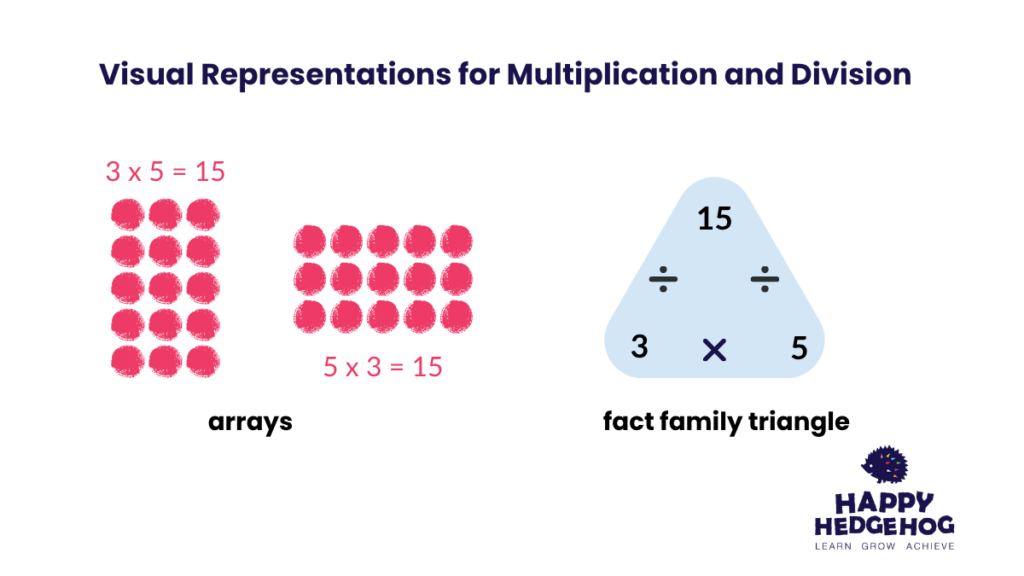
These jottings build understanding and help children spot relationships in their number knowledge.
Happy Hedgehog Tip
Don’t try to learn all the times tables at once.
Focus on one set of facts at a time and celebrate small wins. Children build confidence much faster when they experience success regularly rather than feeling overwhelmed by too much new information.
How to Help Your Child Learn Times Tables
The good news? Small, consistent practice opportunities make a huge difference.
You don’t need hours of drilling.
Instead, try:
- One minute a day focusing on one set of facts
- Counting on fingers in equal steps
- Using visual supports, such as drawing arrays or using counters
- Practising for very short periods but repeating this frequently
There are also some fantastic apps and websites that can help children build fluency in a fun and engaging way.
I am currently developing a Learning at Home programme to help your child master these fiddly facts confidently too. Join my email list to be the first to find out when it launches.
Once your child is confident with their times tables, the next step is applying them to topics like fractions.
Coming soon: How to Find a Fraction of an Amount
A Final Thought
Learning times tables might feel like a ‘slog’ at the moment – but it’s one of the best investments of time you can make in your child’s maths journey.
It builds:
- Confidence
- Speed
- Understanding
- Resilience
- Reduced cognitive load, stress and anxiety around maths
And most importantly … it helps children feel successful in maths.
Times tables are much more than a list of facts to memorise. They are the foundation for multiplication, division, fractions, percentages, ratio and algebra.
Small amounts of regular practice build confidence, reduce cognitive load and help children feel successful in maths.
Free Resources
To support children with their times tables at home, I have created a FREE Times Tables Without Tears Guide to help you pinpoint which times tables your child needs help with and ways in which you can get started at home.
If you found this blog helpful:
Explore more parent-friendly maths guides: